

REP Research Roundup: May 2025
Department news
Department on LinkedIn
The Department of Real Estate and Planning is now on LinkedIn!. To keep up with the amazing work we do please follow us on LinkedIn.
Royal HaskoningDHV Guest Lecture
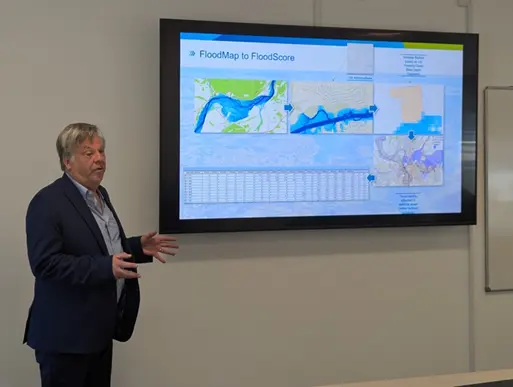
Students on the flexible MSc programmes on Real Estate and Real Estate Investments and Finance at Henley Business School engaged with the critical topic of climate change risks in housing markets.
We were privileged to host Rob Carling from Royal HaskoningDHV, who brings over 30 years of experience in geospatial data and natural hazard risk. Rob together with Vanessa Balmbra shared insights into how climate-related risks, such as flood modelling and physical risk mapping, are increasingly influencing residential real estate decisions and policy frameworks.

RICS Visit
On the 22nd of April, David H. Hourihan (RICS Governing Council Seat Holder) visited to present at the Reading Real Estate Society’s Annual Lectures. The presentation 'RICS - How do I get involved?’ looked at the RICS, types of membership, the role of Governing Council, the APC process and the benefits of joining RICS Matrics.

Undergraduate of the year Awards 2025
Oluwalani Jeremy Oshunrinade won the Undergraduate of the year award, 2025 on Friday the 25th of April.
Students Mithiran Sivapalan and Oluwalani Jeremy Oshunrinade made it to the GRAND FINAL of the annual targetjobs UK Undergraduate of the Year Awards. They were both finalists for 'The Celebrating Social Mobility in Real Estate and the Built Environment 2025' category, sponsored by CBRE. The panel were looking for an undergraduate who demonstrated their resilience, innovation, and commitment to excellence. Someone who is excited about transforming the real estate industry, and passionate about making a positive impact in shaping the future of our communities.
Impact & Engagement Updates
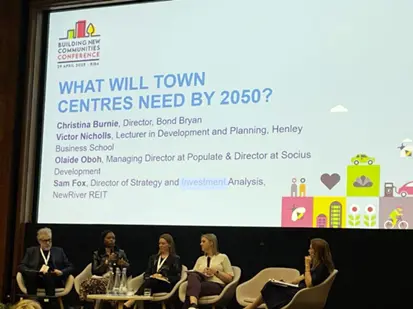
This week, Victor Nicholls, Lecturer in Development and Planning, was invited to contribute to a keynote conference at the RIBA, looking at practical approaches to the creation of a new generation of New Towns. With Dr Emma Street, Victor has been researching New Town centre regeneration over the past ten years.
Their research reports are available for free download here: https://lnkd.in/ebHcbjX2
Research News
Awards

University of Reading’s Early Career Researcher Output Prize (Prosperity & Resilience theme)
Congratulations to Xiaolun Yu for winning the University of Reading’s Early Career Researcher Output Prize (Prosperity & Resilience theme) for his paper in Real Estate Economics, Low-rise buildings in big cities: Theory and evidence from China.
Different forms of land use regulations have been implemented worldwide, such as the zoning policy in the US and the greenbelt in the UK, leading to various social and economic impacts. In this paper, Xiaolun explores the determinants of floor area ratio (FAR) limit, a major form of construction density regulation, in China. He develops a spatial equilibrium framework to study local governments’ optimal FAR design and investigates over 400,000 residential land transactions between 2007 and 2019 to perform the empirical analysis. The research finds that local economic and tax conditions contribute to housing affordability issues and spatial inequality in China.
Research Bids submitted (External)
Gianluca Marcato – Co-Investigator
- Funder: Science and Technology Development Fund (Macau)
- Title: An Innovative Approach to Measure Granular Level Income Inequality and Housing Affordability
- Total project costs: £321,937
PhD News - Public Engagement
Mr Joe Doak gave 2 Talks for the Dorchester Civic Society
· 4th March 2025: Talk to Dorchester Civic Society on 'The Labour Government’s Approach to Planning: What Does it Mean for Dorchester?'
· 8th April 2025: Talk to Dorchester Transport Action Group on ’Sustainable Transport Infrastructure’
PhD Viva
Candidate: Kaio Nogueira
Title: Upzoning and Property Development: Speculative Housebuilders’ Response to Transit-Oriented Zoning Policy in São Paulo
Supervisors: Prof Peter Wyatt and Dr Chris Foye (UCL)
Publications
Burnett, A., Parker, G., Scott, M. and Gallent, N. (2025) Planning for societal challenges and rural capital. In: Scott, M., Sturzaker, J., Gallent, N., Parker, G., Burnett, A. and Mell, I. (eds.) Rural Planning Futures. Principles, Policy and Practice in the UK and Ireland. Routledge, London, pp. 44-59. (In Press)
Chen, X. Fang, G., Kang, J., Hong, B., Wang, Z. and Xia, W. (2025) Language culture and land use: a case study of the dialect cultural regions in Anhui Province, China. Land, 14 (3). 648. doi: 10.3390/land14030648
Abstract
The unity of material and spiritual civilization is among the important criteria for sustainable development and modernization construction. However, defining the relationship between the two has posed a challenge to researchers. In terms of spiritual civilization, many studies on dialect maps reflect the dialect characteristics and cultural features of different regions. Regarding material civilization, changes in land use and behavior have attracted the attention of many scholars, who have extensively discussed their regional heterogeneity. However, few studies have focused on the connection between the two, and discussions on the possible bidirectional interaction between dialects and land use have been limited. Thus, in order to bridge the gap between the spiritual civilization related to language and the material civilization related to land use, this study proposes an interactive theoretical framework and conducts an in—depth analysis by taking Anhui Province in China as an example. Firstly, it comprehensively identifies the dialect types within Anhui Province and maps the dialects. This fundamental work provides a crucial basis for understanding the distribution of different dialect regions. Subsequently, a profound analysis of the spatiotemporal changes in land use in this province over time is carried out. To further explore the characteristics of land use behaviors, this study employs the Latent Dirichlet Allocation (LDA) model to mine the latent semantic topics in the land use-related data, thus enabling a more detailed understanding of the diverse patterns of land use behaviors in different regions. Finally, by uncovering the characteristics of land use changes and behavior differences in different dialect regions, this study explores the possible bidirectional interaction mechanisms. The results show that significant spatial heterogeneity in land use behavior and its driving factors can be observed within different dialect regions. Its bidirectional interaction is manifested in land use behaviors regulating people’s activities through constructing “fields” and forming habits that influence regional dialects and cultures. Meanwhile, under mobility mechanisms, new dialect systems replace indigenous languages in immigration destinations. Land use methods from emigration areas are spread through convenient communication, affecting the cultural psychology and land use behaviors of social groups in immigration destinations. This study expands the boundaries of linguistic and cultural geography, offering a new perspective for the identification of spatial differentiation and new ideas for the governance of spatial differences.
Gallent, N., Parker, G. and Burnett, A. (2025) Planning – engaging relational capitals and supporting the ‘good countryside’. In: Scott, M., Sturzaker, J., Gallent, N., Parker, G. Burnett, A. and Mell, I. (eds.) Rural Planning Futures. Principles, Policy and Practice in the UK and Ireland. Routledge, London, pp. 159-172.
Kladakis, G., Lux, N. and Skouralis, A.  ORCID: https://orcid.org/0000-0003-0835-1457 (2025) Exploring the non-linear dynamics between Commercial Real Estate and systemic risk. Journal of Empirical Finance, 82. doi: 10.1016/j.jempfin.2025.101607
Abstract
The commercial real estate (CRE) market significantly influences financial stability, given its size, use as collateral, and cyclicality. This study explores macro-financial vulnerabilities arising from the CRE market, revealing that adverse developments in CRE capital values amplify systemic risk across financial sub-sectors, namely, banks, insurance companies and investment trusts, consistent with the collateral channel hypothesis. The CRE and financial markets relationship, however, displays nonlinearities. We introduce a UK CRE Misalignment index which integrates various market indicators to assess deviations from fundamental values in the CRE sector. We find that during market misalignments, the link between systemic risk and CRE growth weakens, suggesting that further property price increases in an overheated market could lead to a bubble and heightened systemic risk, in line with the deviation hypothesis. Finally, we employ a quantile regression model that captures another aspect of this non-linear relationship. We find that positive (negative) developments in the CRE market decrease (increase) the right tail of the historical systemic risk distribution, but CRE variation has a weak impact on the left tail and cannot effectively reduce systemic risk in periods of growth.
Liu, N., Zhao, Y., Yan, B. and Hutchison, N. (2025) Tenants’ ESG: influence on preferences and rent premiums for green buildings in commercial real estate. Journal of Property Research. doi: 10.1080/09599916.2025.2494562
Abstract
This paper investigates the impact of Environmental, Social, and Governance (ESG) considerations on occupiers’ preferences and willingness to pay (WTP) for sustainable buildings in commercial real estate. Using lease transactions of office and retail spaces in London, combined with ESG scores from the Refinitiv database, we analyse whether ESG-conscious firms are more likely to choose green-labelled properties, and how their WTP for such spaces varies according to their ESG profiles. Our findings indicate that publicly listed companies, which are more likely to emphasise ESG considerations, are more likely to occupy BREEAM-certified offices. Office tenants with higher Governance scores also exhibit a stronger preference for BREEAM-certified buildings. In contrast, these relationships are not observed in the retail sector. Although tenants’ overall ESG scores are not significantly associated with WTP for green-labelled properties in either market, retailers with strong Governance scores are willing to pay a premium for BREEAM-certified spaces. The link between tenants' ESG scores and their demand for green-certified buildings appears to be stronger in recent years, reflecting the growing emphasis on ESG considerations. Our findings underscore the diverse priorities of tenants across the real estate market and offer valuable insights for property owners in developing effective leasing strategies.
McAllister, P. (2025) Housebuilders’ landbanks: Inventory, asset or hoard? Land Use Policy. (In Press)
Abstract
In the context of longstanding allegations of land hoarding and/or speculation, this paper examines the land holdings of major housebuilders. The paper discusses the concept of landbanking and potential motives for and consequences of holding land inventories. Through a descriptive analysis of quantitative, temporal data of the landbanks of leading, listed housebuilders, the paper analyses the land holdings of residential developers in both the US and UK. The analysis encompasses various aspects including the relative scale of their land holdings, the extent of land ownership compared to control (typically through options) and the evolution of these patterns over time. It is found that the main motives for holding significant land inventories could be operational, investment or anti-competitive but that holding land also comes with opportunity costs and risks. Despite operating in a highly imperfect land market and restrictive planning regime, the large UK housebuilders have been able to maintain significant and relatively stable landbanks. In comparison, the US has seen a major shift towards land-light strategies. US housebuilders increasingly rely upon relatively short-term options, rather than outright land ownership, to secure their pipeline of development plots. The shift primarily aims to hedge risks associated with holding land. Although the comparative evidence is limited and imperfect, it generally indicates that UK housebuilders tend to maintain smaller land inventories compared to their counterparts in the US, Australia, and Ireland.
McAllister, P. (2025) A note of caution on the financial performance of the British housebuilding sector. Journal of Property Research. doi: 10.1080/09599916.2025.2471271
Abstract
In the context of concerns about excessive market power, this paper evaluates the financial performance Britain’s leading volume housebuilders using data on stock market returns as well as accounting-based financial performance metrics for the last two decades. Using descriptive analysis, the financial performance of the housebuilding sector is compared with 18 other sectors, and variation in financial performance among the seven largest listed housebuilding firms is analysed. The findings indicate that the average stock market returns and profits margins for the housebuilding sector have been relatively low compared to most other sectors. Firms in the housebuilding sector typically have more conservative balance sheets with low gearing and large cash holdings. Possibly the most distinctive feature of the housebuilding sector is the size of inventories. There has also been significant variation in stock market performance among individual housebuilding firms, with two companies delivering the majority of the sector’s returns. It is concluded that this variability may undermine the notion of significant market power within the sector, instead highlighting the importance of firm-specific factors in determining financial performance.
Parker, G., Burnett, A. and Sturzaker, J. (2025) The ‘social and cultural rural’: people and rural place leadership. In: Scott, M., Sturzaker, J., Gallent, N., Parker, G., Burnett, A. and Mell, I. (eds.) Rural Planning Futures. Principles, Policy and Practice in the UK and Ireland. Routledge, London, pp. 137-158. (In Press)
Parker, G. and Maidment, C. (2025) The head, heart and soul of planning. Town and Country Planning, 94 (2). pp. 122-127. (In Press)
Scott, M., Parker, G., Sturzaker, J., Burnett, A., Gallent, N. and Mell, I. (2025) Introduction: towards rural planning for the future. In: Scott, M., Sturzaker, J., Gallent, N., Parker, G., Burnett, A. and Mell, I. (eds.) Rural Planning Futures: Principles, Policy and Practice in the UK and Ireland. Routledge, London. (In Press)
Scott, M., Sturzaker, J., Gallent, N., Parker, G., Burnett, A.  ORCID: https://orcid.org/0000-0003-3079-4377 and Mell, I. (2025) Conclusion: planning for rural futures. In: Scott, M., Sturzaker, J., Gallent, N., Parker, G., Burnett, A. and Mell, I. (eds.) Rural Planning Futures. Principles, Policy and Practice in the UK and Ireland. Routledge, London, pp. 173-186. (In Press)
Sturzaker, J., Blair, N., Harris, N., Mabon, L., Parker, G. and Scott, M. (2025) Rural planning policy and governance. In: Scott, M., Sturzaker, J., Gallent, N., Parker, G., Burnett, A. and Mell, I. (eds.) Rural Planning Futures. Principles, Policy and Practice in the UK and Ireland. Routledge, London, pp. 23-43. (In Press)
Vorel, J., Gabas, O., Franke, D., Benesova, I., Kacerevic, S. A. and Makovsky, L. (2025) Hedonic prices of public goods. Czech Technical University in Prague, Prague. (In Press)