

REP Roundup: June
News from the Department of Real Estate & Planning
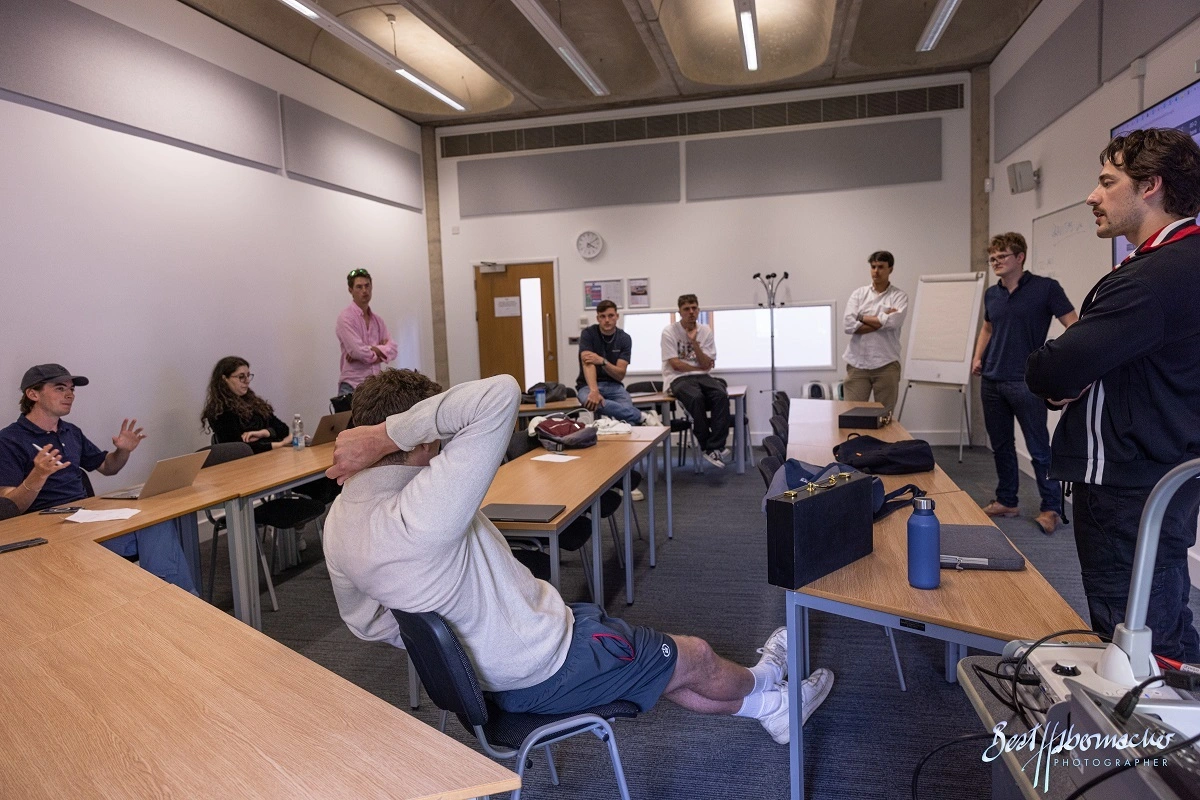
Real Investor Strategy Game
Between June 6th and 9th the MSc Real Estate Students participated in a four day strategy game run in conjunction with Real Investor from Switzerland. The 'Blue Game' is a behavioural approach to the dynamics of property pricing under changing environmental regulation, social responsibility and economic expectations. Using a real world business case based on the Australian property market the game utilises economic and social concepts of game theory. Students teams take on a variety of roles in the game including fund managers, investors, banks and developers.

Women in Property 2023 South East Awards
Real Estate and Planning students, Farah Shah; Bea Adamson and Man Chi Yim were finalists for the Women in Property 2023 South East Awards.
Engagement
Prof. Pat McAllister and Dr Chris Foye from the Department of Real Estate and Planning have contributed to the Competition and Market Authority inquiry in the housebuilding industry. Their response can be found here: Housebuilding Market Study
Keynote speech
Professor Éamonn D’Arcy (Real Estate and Planning) gave an invited keynote speech on “The Recent Evolution of Global Real Estate Markets – Primary Forces & Megatrend Impacts” at the 2023 Real Estate Market Outlook Conference which took place at the Headquarters of Eurobank in Athens, Greece on Thursday June 8th. The conference was jointly hosted by RICS Greece and the British Hellenic Chamber of Commerce. Professor D’Arcy’s contribution provided a number of insights into the wider processes of change that real estate markets have been undergone over the past two decades. The conference also focused on foreign investment in the Greek real estate market, the prospects for various real estate sectors and the challenge of sustainability. The audience included a significant number of Real Estate and Planning alumni from Henley Business School and the University of Reading.
PhD News
Conference presentations
Surma, M (2023) The ‘engaging’ post-pandemic hybrid workplace: The interplay of environmental factors and health-related behaviours for employee engagement; The British Academy/UK and The Alexander von Humboldt Foundation/Germany Knowledge Frontiers Symposium, London. 12-14 May, 2023.
PhD Vivas
Candidate: Teejay Azeez
PhD Title: Household energy practices in Lagos, Nigeria
Supervisors: Dr Richard Nunes; Prof. Chuks Okereke (Geography and Environmental Science Department)
Publications
Burnett, A. and Pain, K. (2023) Linking environmental and human health in English urban development decision-making: the human health literacy of environmental policy.
Built Environment, 49 (2). ISSN 0263-7960 (In Press)
Abstract
In this paper we provide an overview of the UK environmental regulatory framework for subnational policy and planning in devolved English urban areas based on a systematic coding of key legislation and policies against a matrix of sustainability attributes relevant for human health. Our findings suggest that while various elements of sustainability at diff erent scales are addressed to differing degrees, we need to move beyond the ‘three-legged stool’ of sustainability to assess linked environmental and societal health impacts. Assessing policy using a multifaceted lens of sustainability such as the one we propose can help to uncover health-development dependencies and the incentives and governance required to enhance these at diff erent scales (planetary, regional, neighbourhood and building). We propose a coordinative role for spatial planning to integrate responses to socio-environmental health priorities for sustainable development and make recommendations for dynamic decision-making on environmental and human health impacts in urban development settings. Doing so can help promote just (equitable) transitions, decoupled from a pervasive ecological modernization discourse that frames the political economy of planning at both the national and local levels.
Emeghe, I. and Pain, K. (2023) Mental wellbeing, housing provision and social valuation in a United Kingdom context: a planning issue?
Built Environment: Urban Planning and Public Health Special Issue., 49 (2). (In Press)
Abstract
This paper provides insights into the influence of housing quality on occupier mental wellbeing based on a critical review of interdisciplinary literature spanning housing, health and wellbeing, autonomy, and social value. We consider the significance of extant research findings for the mental wellbeing of housing occupants and indicate the relevance for planning. We fi nd evidence of the relationship between housing occupier autonomy for the lived experience of wellness and discuss the need for mental wellbeing valuation to inform social housing provision in the United Kingdom. We introduce an original conceptual framework representing components of the housing environment shaping occupier mental wellbeing and conclude that planning in its coordinative capacity has the capability to connect housing provision with mental wellbeing determinants. To do so, however, will require a radical shift in the present UK politics of social housing provision and planning.
Kwon, H. R. and Silva, E. A. (2023) Matching behavioral theories and rules with research methods in spatial planning-related fields.
Journal of Planning Literature, 38 (2). pp. 245-262. ISSN 1552-6593
doi: https://doi.org/10.1177/08854122231157708
Abstract
Despite the popularity of the “behavioral approach,” there is as yet a lack of guidance on the selection and use of appropriate behavioral theories for specific planning purposes. Based on a literature review of 318 articles in spatial planning-related journals, this paper presents a portfolio of behavioral theories by types of behavior, key variables, rules, and research methods. In addition, based on the survey of twenty-two international experts, it cross-validates the findings and highlights particularly appropriate theories for certain types of behavior dealt in related disciplines. Finally, the paper derives discussion points including the applicability of various behavioral theories in urban models such as space and time-sensitive dynamic simulations.
Kwon, R. and Pain, K. (2023) Searching for health and wellbeing: commercial real estate actor encounters with planning in the urban decision-making ‘Black box’.
Built Environment, 49 (2). ISSN 0263-7960 (In Press)
Abstract
A body of research has highlighted the transformative effects of the financialization and internationalisation of real estate investment for city and regional development. However, little attention has been paid to the human health and wellbeing implications of the practices of the actors who mediate commercial real estate investment flows and their encounters with urban planning. Based on interview evidence from twenty-one senior international real estate industry actors, this paper addresses this gap. Using actor-network theory to assist with deconstructing the interaction between the actors and planning in the urban decision-making ‘black box’, we offer a new way to strengthen theoretical understanding of ‘black boxing’. We find that despite a common perception that the interests of commercial real estate investment and urban planning actors are generally dichotomous, awareness of health and wellbeing has become prevalent amongst major real estate actors as an important component of sustainable investment. We conclude that robust public health evidence is needed to place human health and wellbeing front and centre stage in the urban decision-making black box.
Wu, Y. , Tidwell, A. and Sah, V. (2023) Impact of ethnic and cultural diversity on millennial living preferences and homeownership.
International Journal of Housing Markets and Analysis. ISSN 1753-8270
doi: https://doi.org/10.1108/IJHMA-03-2023-0042
Abstract
In this study, we examine living preference and tenure among millennials, with a particular focus on the impact of ethnic and cultural diversity on housing outcomes including observed homeownership inequalities. Using the individual panel data from three waves in American Housing Survey, 2015-2019, this study compares the likelihood of co-residing among Asian and Hispanic millennials with non-Hispanic White millennial peers. Furthermore, this study estimates the effect of co-residence on homeownership across generational and ethnic backgrounds. We find a preference for coresident adult familial households among foreign-born Asian and Hispanic millennials, and U.S-born Hispanic millennials when compared to their non-Hispanic White millennial peers. The results are robust after considering neighborhood selection bias, affordability, and education. The effect of co-residence on ownership is significant and positive, suggesting this living arrangement contributes to homeownership across all generational and ethnic groups. Housebuilders should be aware of Asian and Hispanic millennials' increased appetite for extended family living arrangements and consider increasing the physical size of affordable or workforce-oriented rental housing and new single-family construction to accommodate more adult co-living arrangements. This study provides a more comprehensive understanding of the role ethnic and cultural diversity has on millennial adult living preferences and its generational differences, which is not just ‘boomeranging’ as identified by previous literature, contributing to the growing interest in the housing research on the effect of ethnic diversity and culture on millennials' homeownership rates.
Murray, C. (2023) Colonial urbanism in the age of the enlightenment the Spanish Bourbon reforms in the river Plate.
Anthem Studies in Latin American Literature and Culture, 258. Anthem Press. ISBN 9781785279812
Wong, C. , Pain, K. , Kwon, R. and Koksal, C. (2023) Urban planning and public health.
Built Environment, 49 (2). ISSN 0263-7960 (In Press)