

REP Research Roundup: November 2025
Welcome to your November Real Estate & Planning Research Roundup.
Department News: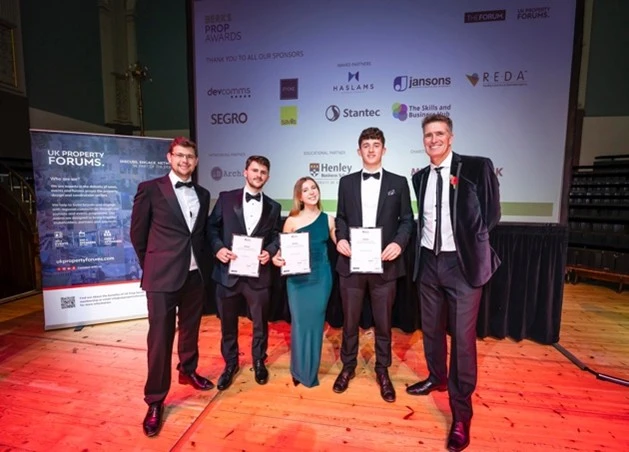
Best Final Year Undergraduate Development and Planning Project Prize
Congratulations to Emily MacGregor, Alice Kirscher, Tom Williams, James Lloyd-Jones and Heli Thornton for willing the Best Final Year Undergraduate Development and Planning Project.
Photo credit (must be included if using the photo): Stewart Turkington
New PGR Director for REP Appointed:
Dr Emma Street has been appointed as Postgraduate Research Director. Many thanks to Prof. Pat McAllister for his exemplary service PGR Director for REP for many years.

Henley Award for Research:
Prof. Carlo Corridini has received a Henley award for Research. The award recognises Carlo’s leadership and commitment to supporting colleagues’ research development.
PHD News:
 Gabriel Gyojun Shin, PhD researcher in @Real Estate & Planning at Henley Business School, has been awarded the Top Research Award, recognised and formally conferred by the Deputy Prime Minister and Minister of ICT of South Korea.
Gabriel delivered his presentation at the prestigious government-backed AI Policy and Public Sector Innovation Forum, jointly hosted by Hanyang University and the Ministry of Science and ICT (South Korea). His presentation, titled “Is Generative AI Trustworthy? The Evidence Behind Bias and Hallucinations”, examined structural bias, hallucination risks, and accountability challenges in large language models (LLMs), including ChatGPT. The study introduced a comparative framework for assessing LLM reliability in public-sector governance and financial system applications.
His research was selected as the Best Paper among 50 national submissions and formally recognised by the Deputy Prime Minister and Minister of ICT for its rigorous quantitative approach and strong interdisciplinary contribution to AI governance and public policy. At a time when generative AI systems face heightened global scrutiny over issues such as hallucinations, embedded bias, and model transparency, Gabriel’s study provided empirical evidence and comparative benchmarks that directly inform institutional oversight frameworks. It stood out for its robust methodology in measuring and interpreting failure modes in LLMs, and for presenting policy-aligned recommendations grounded in international governance standards. The research attracted considerable attention from both academic and governmental stakeholders for its practical relevance to AI regulation, particularly in high-stakes sectors such as finance and public administration, where algorithmic accountability is rapidly becoming a legislative priority.
The paper is scheduled for publication in an AI-specialised academic journal later this year. As part of the award, Gabriel received a £3,000 postdoctoral research grant, which will fund his continued inquiry into AI risk mitigation, regulatory frameworks, and the integration of generative AI technologies in financial and institutional settings.
Research Bids:
Ziyou Wang – Regional Studies Association
- Title: Public perception of climate change and everyday consumption
- Total bid: £4976
Pin-Te Li – Leverhulme Trust
- Title: Bridging the Affordability Gap: Supporting First-Time Buyers
- Total bid: £66972
Publications:
Parker, G. and Dobson, M. (2025) Time and the ‘temporal turn’ in planning theory and practice: an agenda. Town Planning Review. (In Press)
Shi, S., Lin, Z., Zhang, Y. and Pain, K. (2025) Cashing in on others’ misfortune: institutional investments in China’s commercial property market in times of flooding crisis. International Review of Economics & Finance. (In Press)
Abstract:
Flooding disasters have extensively disrupted productive activities, causing market uncertainties. However, how these uncertainties affect institutional investors’ strategies in the commercial property market remains an underexplored question. To address the question, we provide a novel perspective by classifying flooding events into seasonal and climate change-induced (CCI) floods. Specifically, we conduct a spatial quasi-natural experiment to examine the treatment effect of seasonal and CCI floods on the commercial property market in Chinese cities from 2010 to 2018. We find that flooding disasters create a discount effect on property prices, which lures investors to flock into the market. However, institutional investors perform more cautiously in properties within CCI floodplains relative to counterparts within seasonal floodplains. In addition, local institutional investors benefit from higher discount premiums more than non-local institutional investors in floodplain markets, though this advantage diminishes in CCI floodplain markets. Our findings provide valuable implications for investors’ decision-making in flood-prone cities. Policymakers are encouraged to promote market information transparency and resilience-building initiatives to mitigate the adverse effects of flooding events on local economies.
McAllister, P. (2025) Developer or Land Owner Contributions? Land Value Capture, Creation, Conservation and Compensation. Town Planning Review.
This paper examines developer contributions as a planning policy instrument for capturing land value for communities. Drawing on existing literature, it synthesises theory and develops analytical frameworks to classify land value capture mechanisms, ranging from incidental to explicitly designed. Developer contributions are categorised by their effects on land values and provision of public or merit goods, as enabling, commercial, compensatory, supplementary, redistributive, or subsidised. The analysis highlights challenges in determining who ultimately bears the cost - site owners, nearby landowners, developers, end users, or through unrealised economic rent, subsidies, or combinations thereof - making assessment of value capture complex.
