

REP Research Roundup: October 2024
Department News
The 2024 UK-Ireland Planning Research Conference
Planning for Nature/Nature of Planning was hosted by REP at the London Road Campus of the university from Monday 2nd to Wednesday 4th of September. The Conference saw around 70 papers presented, complimented by 6 roundtables. In total there were just over 100 participants, mainly planning academics, but we were also pleased to welcome practitioners, including from central government and the Royal Town Planning Institute. A key aim was to use the conference to bring practice and academia closer together. This was reflected in the make-up of our three plenary panels, addressing planning for nature, the future of the planning profession, and planning education, and our keynote, which saw Hugh Ellis, Policy Director at the Town & Country Planning Association, paired with one of our alumni as a discussant. Many thanks to the Conference Organizing Committee and in particular Chris Maidment, Chair of the Conference Organizing Committee for planning and organizing the Conference.
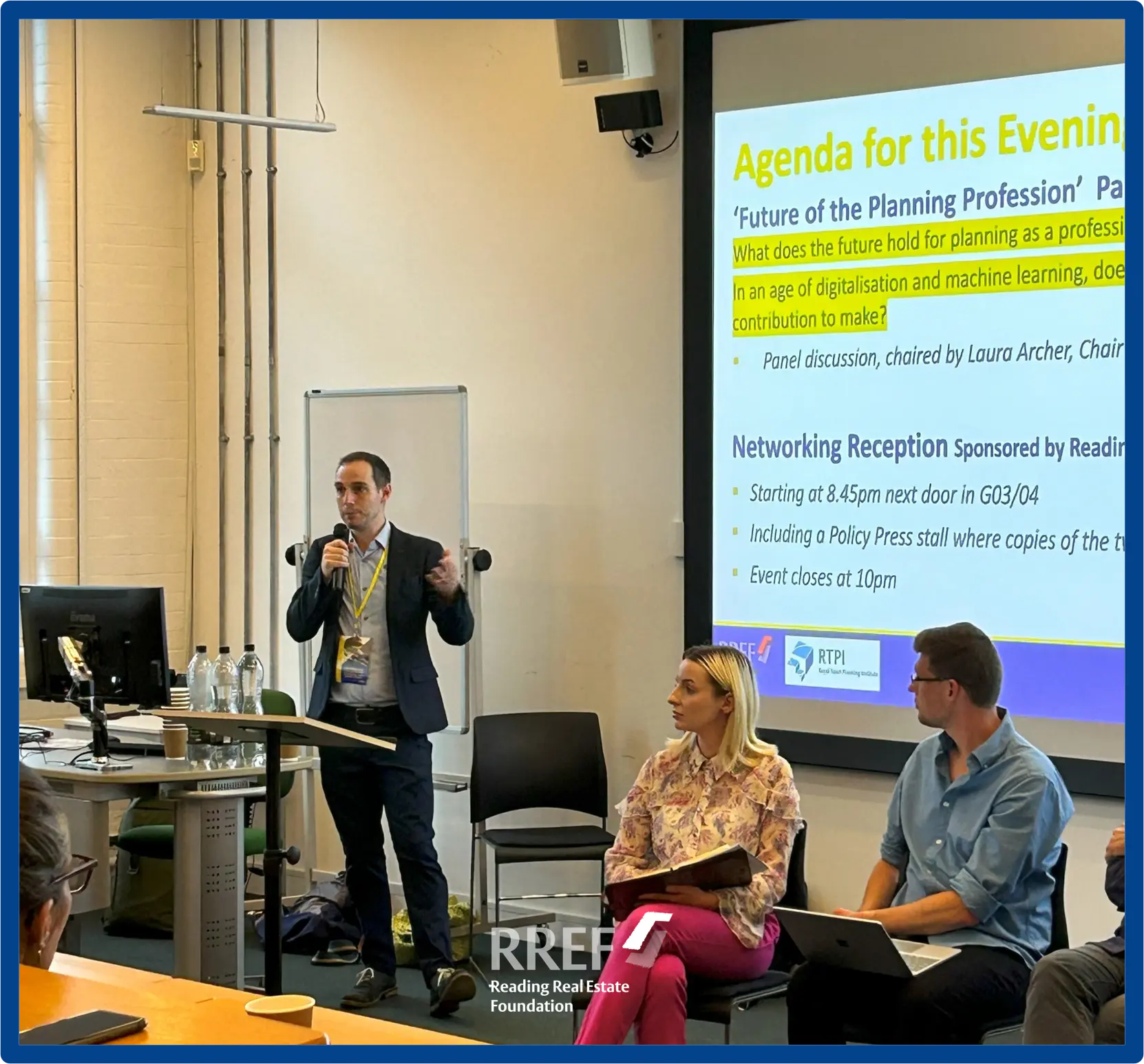

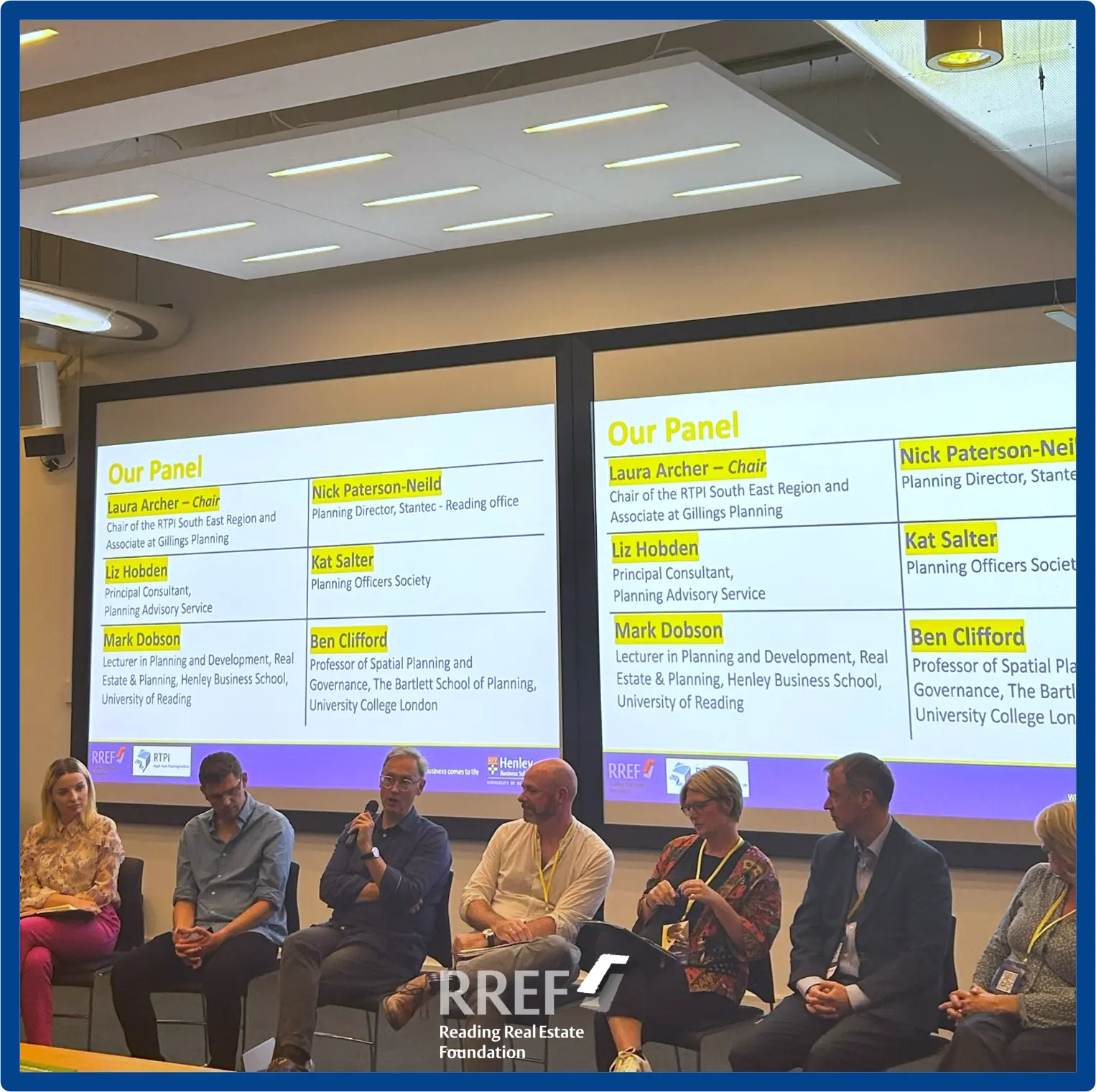
Images from the Planning Conference, Panel Discussion followed by networking
Thames Valley Property Awards 2024
Prof Kathy Pain was one of five judges that adjudicated decision on finalists nominated by the sponsors for the Thames Valley Property Awards 2024. For more information on this please visit https://thebusinessmagazine.co.uk/companies/thames-valley-property-awards-2024-winners-announced/
Research Awards
Claudia Murray
- Name of the Award : University’s ODA Institutional Support Grant
- Title of Project : ‘Regenerative Climate Resilient Interventions with Vulnerable Communities’
- Total bid: £18,500
Research Applications
Pin-Te Lin and Yuan Zhao – Research Grants of the European Real Estate Association (EPRA)
- Title: Listed Real Estate for Institutional Investors
- Total bid: £16,413
- Total for REP: £16,413
Claire Deng - Research Grants of the European Real Estate Association (EPRA)
· EPRA Research Grant
· Green Shifts, Socially Responsible Investing and Capital Raising
· £15,024
Publications
Black, D. , Bates, G. , Callway, R. , Pain, K. Kirton-Darling, E. (2024) Short-termism in urban development: the commercial determinants of planetary health. Earth System Governance, 22. doi: https://doi.org/10.1016/j.esg.2024.100220
Abstract
This article focuses on how short-termism impacts on the quality of urban development and, in turn, both population and planetary health. The first section of the paper clarifies key terms - short-termism, health, urban development and upstream - then summarises the context of urban development in the United Kingdom, and the evidence linking urban environments to population and planetary health. The main analysis section draws on data from interviews with 132 participants carried out between May and September 2021. Using the Commercial Determinants of Health framework, six thematic areas are identified: Policy & Political Economy; Legislation and Regulation; Commercial Actors; Underlying Drivers (Power); Externalities; and Partnership. Analysis suggests 16 key messages, the majority of which point to the need for stronger government intervention, a position supported by private sector, if fairly enacted.
Chettiparamb, A. (2024) Planning from a systems perspective at the frontier: complexity in the past and present. In: Allmendinger, P. M. Tewdwr-Jones, M. and Wargent, M. (eds.) Critical Planning Futures: New Directions for Planning Theory. Routledge, Abingdon. (In Press)
Abstract
This chapter critically examines the foundations of a systems theoretical position in planning over time, in particular discussing to what extent and how an appreciation of social complexity has been embedded or not in these perspectives. Both the ontologies and epistemologies of various systems traditions over time are discussed before key distinguishing features of current systems thinking in planning is explained and examined for how social complexity is conceptualised and dealt with.
Wang, Z., Hui, E. C.-m. and Liang, C. (2024) Developer sentiment, developer’s strategy and housing supply: evidence from Hong Kong. Regional Studies. doi: https://doi.org/10.1080/00343404.2024.2377675
Abstract
The increasingly important role of sentiment in the housing market has complicated the challenges facing developers during boom-and-bust cycles. This study investigates how developer sentiment affects developers’ decision-making and the housing supply at the project level. As the standard evaluation usually overlooks sentiment resulting in suboptimal inferences, we develop a new theoretical mo del that analyses both sentiment and developers’ optimal strategies. Our findings suggest a ‘U’-shape relationship between developer sentiment and the expected waiting time to develop. Second, the optimal development density declines when developer sentiment intensifies. The Hong Kong housing market is used as a case for empirical analysis.
DBA thesis deposit
Pasalis, J. (2024) Spatial dynamics of house price changes and investor demand impact. DBA thesis, University of Reading. doi: https://doi.org/10.48683/1926.00117926
Abstract
During housing booms and busts, home prices appreciate and depreciate at very different rates across markets within the same country. However, one thing that is not clear is whether the heterogeneity in house price dynamics we see in markets across a country extends to different municipalities within large metropolitan areas. When a metropolitan area experiences a rapid change in house prices, do house prices deviate from equilibrium homogeneously across the metro area or do some municipalities and house types deviate further than others? Suppose it is the case that home prices deviate heterogeneously across municipalities and house types within a metropolitan area. Does this mean economists are likely to miss the earliest warning signs of overvaluation and a potential housing bubble since any overvaluation in one market segment would be diluted by balanced or undervalued prices in another market segment? Furthermore, what impact does a change in the demand for single-family homes by investors have on house prices across municipalities and house types in the same metropolitan area? The U.S. states that saw the highest volatility in house prices during the U.S. housing bubble of 2006 saw a rapid increase in the demand for homes by investors. Does demand from investors change over time? Do investors gravitate to buying in certain municipalities vs. others, and if so, what impact does this have on house prices? This thesis will address these questions within the context of the largest metropolitan area in Canada. This research uses a dataset of housing sales and rental transactions in the Greater Toronto Area between 2006 and 2019. It isolates 38,561 properties sold and then rented within twelve months of the sale date. This research compares the user costs of owning to the cost of renting each home to test whether a home’s sale price can be explained by fundamental factors or whether the price has deviated from equilibrium. The research found that houses and condos deviated from equilibrium heterogeneously, with condo prices remaining relatively balanced even when houses in the same municipality deviated significantly from equilibrium. Home prices across municipalities showed signs of homogeneity in their direction when deviating from equilibrium but were heterogeneous in the degree of their deviations. Changes in investor demand were more effective at explaining changes in the P/R ratio and deviation from equilibrium for houses than for condos. Finally, this research explored different estimates of user costs to consider cross-sectional differences across house types and price segments. Using a depreciation rate with a declining sliding scale based on the quartile of the home's sale price to account for cross-sectional differences in land value and using different estimates of the maintenance expense for houses vs. condos improved the model’s ability to explain changes in the P/R ratio.
Visit our Insights page to read past news from the Real Estate & Planning Department and Henley Business School