

MP1 celebrates 50 years of the MA
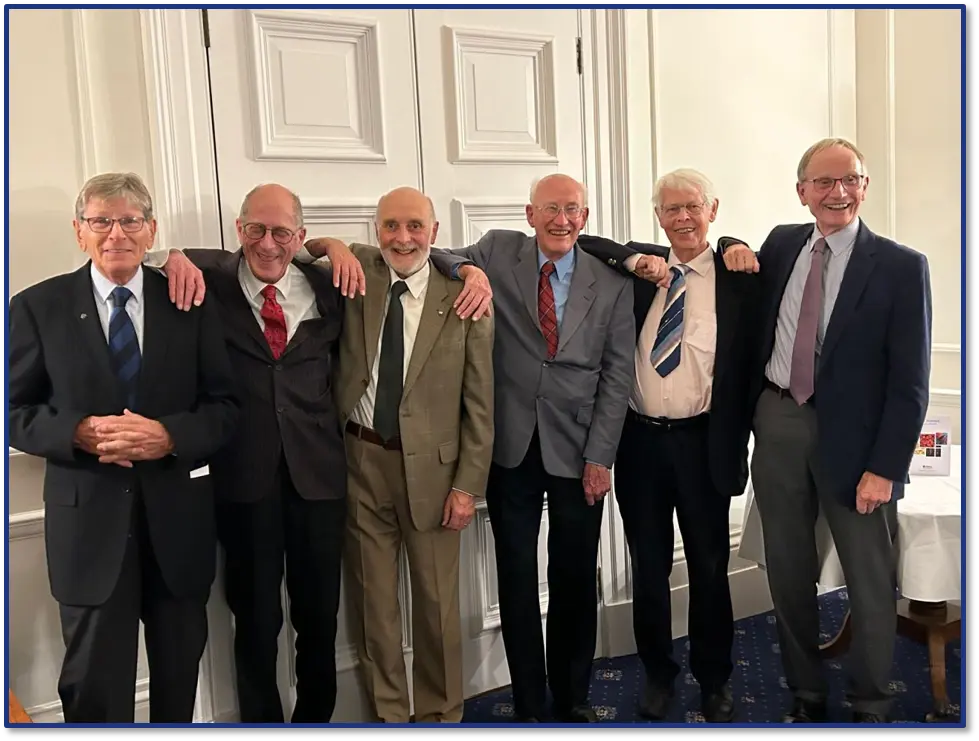
Our first Masters Programme cohort celebrated a slightly early 50th anniversary this month. Some of the original cohort pictured below marked the 50 years with a lunch at Greenlands in the Blue Room. They started the Henley MA - the equivalent of an MBA - in 1974, and all used their experience of the course to progress to roles across senior executive banking positions, local government, heading a fast-food chain and being an independent consultant to name a few.
The Financial Times wrote about this new course in September 1974 under an article entitled: Henley's formula for business schools. Read a snippet from the article below:
The rural calm of Greenlands, the aptly-named seat of the Administrative Staff College at Henley, it is scarcely the place for revolution. Yet revolution is not too strong a word to describe Henley's latest activities, in the rather claustrophobic world of business schools.
It started over a year ago when, under the leadership of its Principal, Professor Tom Kempner, Henley became an associated college of Brunel University. This allowed it to run its own two-year post-graduate "Masters Programme" leading to the equivalent of an MBA (but carrying the more modest and anonymous epithet of MA). Kempner, previously the director of the Bradford Management Centre, brought in Ray Wild, also from Bradford, as director of graduate studies to devise a suitable course.
From the start it was clear that Wild was alive to the criticism directed at business schools by businessmen. Rather than adopting a policy of evolution, in which conventional business administration courses are given a face-lift to improve their appeal, Wild opted for a thorough-going radical approach.
The Masters Programme revealed a year ago caused quite a sensation. Instead of the conventional mixture of lectures, case-studies projects and background reading carried out at the place of learning, he decided to try a sandwich course. There were going to be four "modules" of seven weeks spent at Henley, intersperesed with three 14-week periods spent back with the sponsoring company or in some other real life working environment. The idea, quite simply, was to ensure that learning was put into practice at the earliest possible moment.
When Henley revealed the structure of the course there was an immediate and apparently enthusiastic response from many companies. One bank wanted to send 10 of its bright young men on the first course, despite the fact that Henley was only planning for 15-20 students the first time round. In the event the applicants were whittled down to 15 with representatives from Barclays Bank and National Westminster, the British Gas Corporation and the National Freight Corporation, Shell-Mex and BP, Cadbury Schweppes and the CEGB among them.