MapAid: Connecting the seeing with the doing
Notes from a hybrid business person & aid worker: Chapter 6
Connecting the seeing with the doing
The front-line news today is our world is gripped in battle with two types of dictators - the human variety and the variety caused by climate change. In both cases, there is no respect for man or woman. Does this all feel a bit preachy?
Recently my wise old Dad questioned me on this, which felt like a healthy ego check, on me. Or is it simply calling out the truth? The problem with calling out the truth, be it giving a speech, answering a pub quiz, rendering a sermon or a lecture, is it can involve both the audience and the speaker in confrontation with their own personal trauma, possibly leading to a loss of face. The sense could be that what I am speaking, or what I am hearing, is rather uncomfortable, that I’d rather dive back under my duvet with a delicious cup of hot chocolate!
Aged eleven I went with my family on a holiday to the South of France, where we spent good times with a splendid fellow, the retired Flight Lieutenant Sydney Hastings Dowse (Military Cross). On the hot French beaches, Sydney would tell us of the days when he had been taking reconnaissance photos, in his Spitfire, while flying and fighting for his country and indeed his life. Here you have the great storyteller with wide-eyed children listening. And yes, Sydney spoke from first hand evidence of his own trauma, which I recount here. He told us of a fortune teller on Brighton Beach in England, who told him he would receive a serious leg wound, but under no circumstances was he to let anyone cut his foot off. Exactly this happened, when having been shot down, the German surgeon strongly recommended foot amputation. And there he was, with his two perfectly good legs and feet, sitting in front of an eleven-year-old kid and his sisters. Everyone, was wide-eyed.
Last week I walked past a pub in Marlow, England and scribbled on the blackboard outside were these words by Winston Churchill: “A pessimist sees the difficulty in every opportunity; an optimist sees the opportunity in every difficulty”. This points not only to the linkage between seeing-and-doing, but to going deeper. According to Churchill, being an optimist catalyses a vision, especially when it comes to doing something.
It led me to think of the lines in the poem Prospice by Browning: “For sudden the worst, turns to the best, to the brave…”
And what next? While feeling traumatised by any truth, what next? Actually, I think quite often it’s the smallest of tweaks that can sometimes produce the most amazing results after the vision of a problem has been ingested. Just a tiny bit of personal courage can change things.
Take for example the story of John Snow (1813 -1858) an English physician in London and a leader in the adoption of anaesthesia and medical hygiene, who was a friend of the Anglican priest Rev Henry Whitehead (1825 – 1896).
This unlikely duo had totally different skill sets, but they liked working together. Because of that capability, were able to capture the data, analyse it, and track the source of the 1854 cholera outbreak in Soho, London, to a suspected water pump in Broad Street.
Look at their map below. They could see a high-level vision of the disease. They took a leap of imagination and deduced the devil could be in the water, although on the face of it the water from the pump was as clear as day.
They could have stopped at that point.. but they didn’t. Their next step was to show it to the local governing authority, “The Vestry Committee” who were persuaded to let them un-bolt the handle of the water pump.
The result of this small tweak was the epidemic stopped in its tracks inside in two days.
This result eventually helped trigger a whole new branch of public health analysis, that has benefitted millions of lives ever since.
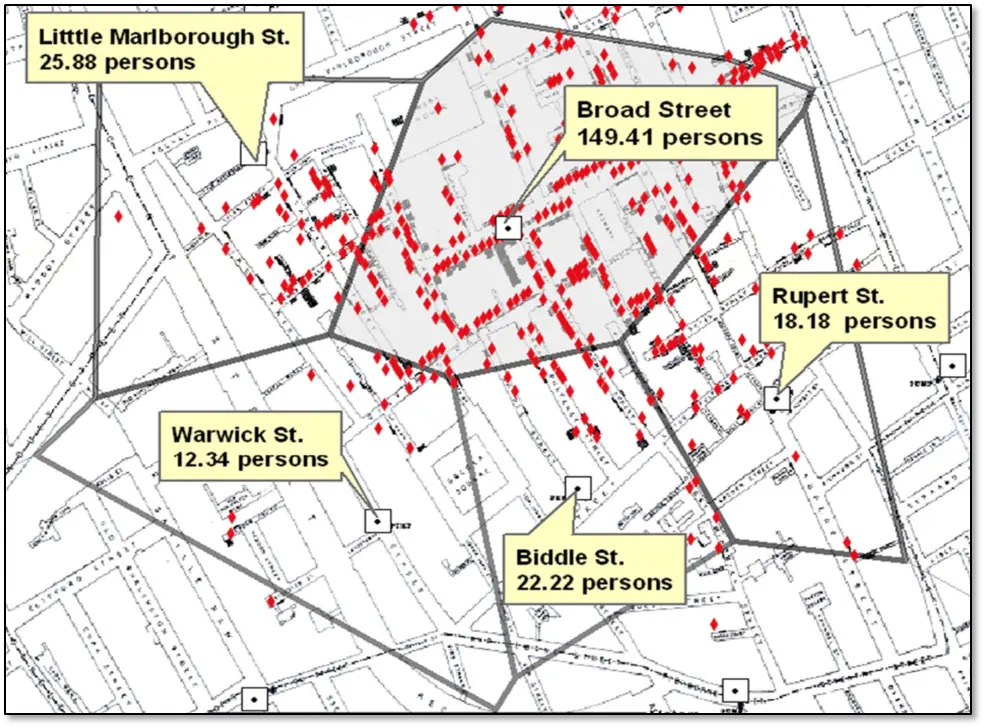
From the original London epidemic of 1854, drawn and lithographed by Charles Cheffins.
The numbers show deaths per 1,000 pax.
So what?
Where does this leave you and me and our world, in the state it’s in ? With a nasty war threatening Europe and international global food supply chains across the Black Sea creaking, and increasing millions of people in the developing world now in dire straights?
This July 2023, multiple land and sea heat records have been smashed by climate change with firestorms in some places and torrential rains in others? So what?
We hold our nerve. We don’t back down.
Maybe we choose a narrow slice of the action within a wider tyranny, something manageable, as did Snow & Whitehead. We assemble the first-hand evidence and then “our map”. Perhaps first we build an unlikely partnership, to complement our skills, or join an existing cause, which may at first feel like visiting the zoo. We then begin to chip away patiently by word of mouth, or non-violent campaigning, as a team… and never give up.
“For sudden the worst, turns to the best, to the brave…”
Follow Rupert's story of how he founded MapAid, how he grew the idea, and what their solutions are for today's issues in this content series.
To learn more about MapAid, visit their website at the button below: