
MapAid: Cutting through the smog of war
Notes from a hybrid business person & aid worker: Chapter 5
Cutting through the smog of war
Last month in this column we considered how in a post conflict situation the smog of poor knowledge covers and hides places on the ground where small enterprise development is needed, such as once a war is over, in a place like Kosovo.
And we saw a map made after the war in April 2000, that uncovered the situation, showing the majority of small economic aid had gone to the west of Kosovo. The reason for this concentration was probably as the German government had worked out where their Kosovar refugees were coming from, and sensibly had focused much of their sustainable job creation and small enterprise grants, in those places. This strategy would have helped encourage returnees from Germany to go back home and start to work. The self confidence a paid job brings to such returnees, would have begun to solve perhaps 80% of their trauma and therefore helped local peace-making and reconstruction efforts.
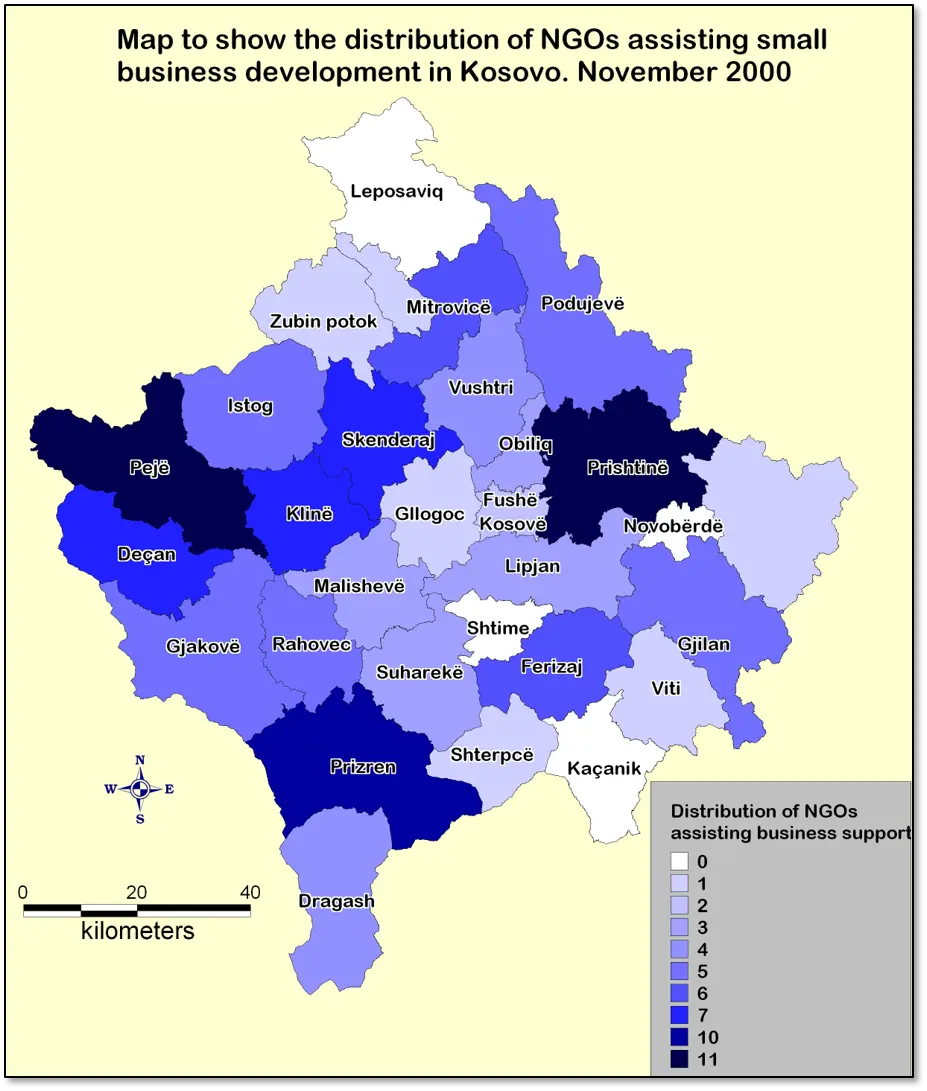
This was not the end of the story, because my local NGO mapping team made another data collection exercise in November 2000 and produced the map below.
This shows that during the seven months from April to November, the economic aid agencies had seen the gaps - and without a squeak put their investments and efforts in those gaps, to the east, the south and the north of the country.
The international community spent an estimated US $2 billion in the immediate post-war economic and shelter reconstruction phase, although this figure is unclear and probably 50% was lost to due to lack of accountability and mismanagement, according to Dr Sam Vaknin who in his blog The Treasure Trove of Kosovo wrote these words a few weeks after the war ended on 11th June 1999:
“Nothing like a juicy, photogenic human catastrophe to enrich corrupt politicians and bottom-line-orientated, stock-option-motivated corporate executives. The Balkan is teeming with both these sad days.
Even as the war was raging, shortages of food and other supplies led to the dispensation of political favours (in the form of import licences, for instance) to the chosen few. Bulgarian, Greek and Albanian firms, owned by ruthless criminals and criminals-turned-politicians benefited mightily. Millions were made and shared as artificially high prices were maintained by various means while cronies and crime controlled firms shared the spoils. This orgiastic intercourse between the corrupt and the criminal was not confined to one country. The whole region partook in robbing the most impoverished populations in Europe by "legal" means.
Their more refined and perfumed Western brethren were never far behind in taking advantage of American largesse on the one hand and re-emerging alarmist tendencies, on the other. Thus, American, German, Greek, French and Italian firms enjoyed funds allocated to international humanitarian aid by the likes of the US government, the United Nations, the World Bank, the IMF and other long arms of the American octopus. Defence contractors and the dubious characters known as weapons intermediaries stoked the atavistic fires of war in securing defence contracts.”
I too was there and ask myself is Dr Vaknin correct? I can only speak from personal experience, but I do remember begging a UN official to help restart a local brick making company, but no, the bricks had to be imported from Greece, at vast expense.
Dr Sam Vaknin goes on to lambast aid workers in expensive four-wheel drive (FWD) vehicles. However, I was there and would like to make some distinctions. Aid workers who worked for the United Nations or the World Bank, or the embassies of their countries, did indeed drive around in FWDs. Nonetheless, many of these vehicles were occasionally work horses, making food & aid deliveries to inaccessible locations. However, those of us who worked for non-government aid agencies (NGOs) often did not have the luxury of a dedicated FWD. As NGO aid workers, we often hired local FWD’s, or purchased a clapped-out banger - while our pay cheques were usually half those of aid workers in the international government aid agencies.
Ukraine
Either way, how do we apply all the above to today’s war in Ukraine? Are there lessons here for when the war ends? Will there be an orgiastic feeding frenzy of contracts flying around? Will it be coupled to corruption and backhanders… making a few people in the capitalist system, inside and outside Ukraine, very rich, while many of the foot soldiers who literally won the war, remain jobless and traumatised?
Or will the Western political and civic Leadership step up to the plate and together with the Ukrainian Leadership, put aside the more liberal tendencies for a “laissez faire or free market” and impose a more “paternalistic version of capitalism”?
“Paternalism” as our wise American and European grandfathers defined the word, to regulate and make transparent the successful handling of economic aid delivery, via the Marshall Plan after World War 2 in Europe.
Consider West Germany, that was at economic zero, at the end of the War but within 20 years of the start of the Marshall Plan was economically more successful, than the United Kingdom, in both absolute and per capita terms:
“In 1968, the GDP of West Germany was approximately $153.7 billion (in current US dollars). Meanwhile, the GDP of the United Kingdom was approximately $122.2 billion (in current US dollars). These figures are based on historical economic data from the World Bank.”
“In per capita terms, this is reported as $5,618 for West Germany and $5,117 for the UK.”
Source: ChatGPT
When I asked ChatGPT “What made the Marshall Plan a success ?”, it listed eight enlightening points, that make good sense, the final one being:
“Aid Conditionality: Aid was made conditional on the implementation of appropriate economic policies, financial accountability, and transparency. This encouraged responsible use of the funds and discouraged corruption.”
What could be more helpful for transparency than a map from honest data?
Follow Rupert's story of how he founded MapAid, how he grew the idea, and what their solutions are for today's issues in this content series.
To learn more about MapAid, visit their website at the button below: