MapAid: Maps help cut through smog
Notes from a hybrid business person & aid worker: Chapter 4
Maps help cut through smog
Last month, I mentioned here both in UK and Europe our energy is as costly as the most expensive type offered on the market and just now this is oil and gas. This is due to governmental regulations and is bonkers. I also mentioned that 80% of the board members at America’s top six banks are climate conflicted, according, an Anglo-American group of journalists called to DeSmog. That too feels bonkers.
What of smog? Well, this month New York has unfortunately been covered in smog from wild fires across North America, made up fatal combustion of fossil fuels exhaust, wildfires, and dust storms. Such smog reminds me of that day in eastern Kosovo, in the winter of 2000, when I was in working in humanitarian emergency aid, in a city and region called Mitrovica.
In the city are two major ethnic groups, the Serbs north of the river and the Kosovars to the south, who don’t much like each other. That’s sad because both sides were charming to me, during my time leading a UNHCR house rehabilitation team.
On one occasion I had to visit the city hall library, near the river, which divides the Serbs in the north from the Kosovars to the south. At about midday I strolled outside, to find a blanket of smog hanging over the streets, and lots of shouts. The French Army were seriously animated, so too were many people, mostly young men. The smog reminded me a little bit of the white clouds hanging over Notting Hill Carnival. The only difference being tear gas to weed.
It began to dawn that people must have better things to do, than hurl rocks at the neighbours, but this swiftly compounded my earlier understanding they didn’t have better things to do - because there were no jobs - and everything was a mess. Therefore, they were angry. This was a hotspot.
In the following weeks, I asked around and realised nobody in aid or related economic sectors was identifying and picking the lads off the streets and helping them set up small chicken farms, or small risk diverse industries, 100 kilometres due north and due south of Mitrovica, so they could afford to do something better, like look after Mom & Pa, or take their girl out to dinner.
Early in the spring of 2000, I left the UNHCR and helped to set up a team of local people, as an NGO, to make maps in Kosovo, and one of the first things we did was to make a map showing only the absolute numbers of NGOs promoting small businesses start ups, across Kosovo.
Here’s the map showing what we found. Please note, darker areas mean more activity:
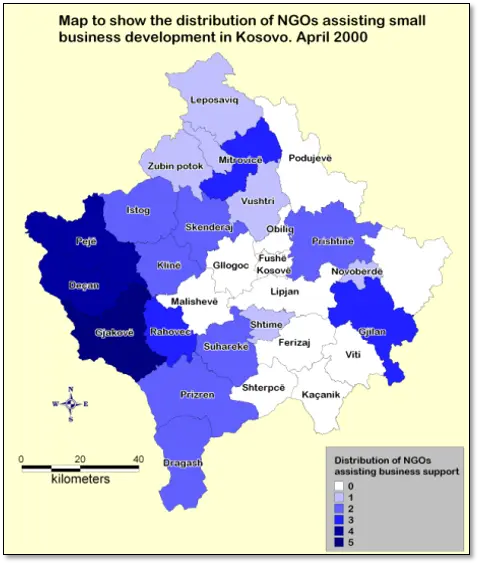
As you can see, there was a clustering to the west. You may ask why ? Was this a hotspot ? Well, after some research we discovered the German government had done a survey among its own Kosovar refugees and discovered most came from the west, so this became the German focus. For the Germans it was a hotspot, to help persuade their refugees from Germany to return home and carve out a new future.
The German government and NGOs seemed to me to be the most active of all countries in economic development for which they deserve credit. However, in the post conflict era it also became evident that the destruction of Kosovo was the indiscriminate and widespread, no place seemed to escape.
In November 2000 in Pristine the capital of Kosovo, I put a small pile of our maps showing this result, on the table at a business start-up meeting for leaders working in economic recovery. Two minutes later it had disappeared. This is perhaps unsurprising given that nobody much likes smog, but secondly, at the end of the conflict Kosovo faced serious social problems, with the International Organisation for Migration estimating that over 70% of the population were ‘supported persons’, compared to just 14% relying on income from work and 4% receiving a pension or social income.
So, some final thoughts. I asked Chat GPT what youth unemployment was in both Kosovo and Bosnia today. It replied that in 2020 youth unemployment, (defined as those aged 15 to 24 years old) in Bosnia was around 53.9% and in Kosovo approximately 43.8%, according to the World Bank.
On my MBA at Henley Business School, I formalised my knowledge of what happens when there is not enough capitalism at the ground level, when angry youth don’t have jobs, in small risk diverse businesses. In summary, the United Nations and several other commentators report the two dark factors that ignite war are unemployment and unequal economic growth. As part of a wider strategy, small business start ups can therefore have a fundamental peacebuilding effect, at the ground level, to prevent these dark factors and stop power falling in to the hands of the dictators.
Next month I will share a second map cut, for November 2000 that showed what happened when our local NGO went back and evaluated what had changed since that April.
Follow Rupert's story of how he founded MapAid, how he grew the idea, and what their solutions are for today's issues in this content series.
To learn more about MapAid, visit their website at the button below: