

REP Research Roundup - October 2026
Departmental News
Vice Chancellors’ Awards
University Teaching Fellowship
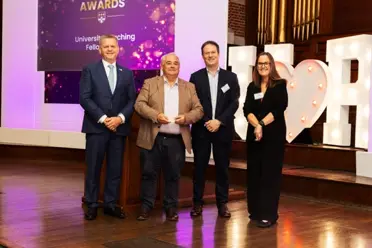
Eamonn D’Arcy was awarded a University Teaching Fellowship in recognition of "outstanding commitment to innovative teaching and learning, integrating real-world tasks and industry engagement. He has also achieved significant impact through supporting colleagues’ development and sustained leadership of international real estate education networks”.
Highly Commended in the ‘Research and Innovation’ Category
The Reading Latin America and the Caribbean Research Network was “highly Commended” under the “Research and Innovation Community” category and was described as "highly active and benefits our research culture by developing and supporting interdisciplinarity”. REP staff, Claudia Murray as Co-Chair of this network; Richard Nunes as Student Manager of the network and Ricardo Daza were recognised for their contribution to the Network.
Best Paper Award at the AfRES conference

Dr Ibrahim Dabara Daniel received the Best Paper award at the AfRES conference for his paper titled “Navigating Algorithmic Valuation: Institutional Logics, Interpretability, and Practitioner Agency in an Emerging-Market Context”. It examines how Automated Valuation Models (AVMs), machine learning and artificial intelligence are changing professional real estate valuation, with particular attention to the challenges of applying these technologies in emerging and data-constrained property markets.
Honorary Lifetime Contribution Award from The African Real Estate Society (AFRES)

Professor Éamonn D’Arcy (Real Estate and Planning) was given the Honorary Lifetime Contribution Award of the African Real Estate Society (AfRES) at its 25th Annual Conference held in Kampala Uganda, September 8th-11th.
The award sponsored by the Royal Institution of Chartered Surveyors (RICS) was given in recognition of his outstanding contribution to the advancement of real estate scholarship and education across Africa.
Image: Abdullah Akaish (RICS) presenting the award to Professor D’Arcy
MSc London Field Trip 2026-27
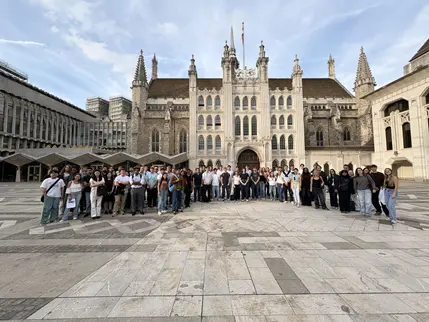
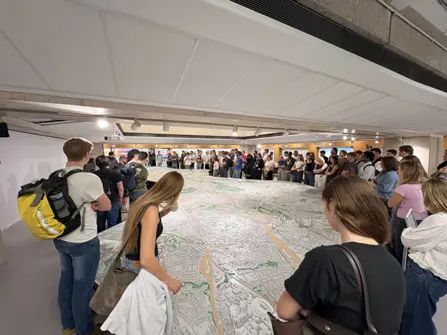
With the start of a new academic year, the department welcomed over 170 new postgraduate students in the MSc Real Estate, MSc Real Estate Finance and MSc Spatial Planning and Development programmes. As part of the Welcome Week activities, they took part in the field trip to London where they visited world-renowned urban projects such as King's Cross, Stratford City and Canary Wharf. The trip was designed to introduce students to the fundamentals of good place-making by looking at paradigmatic examples of real estate and planning practices.
RESEARCH AWARDS
External awards
Xiaolun Yu - with Christian Hilber (LSE) and Olivier Schöni (University of Lausanne)
Funder: Swiss National Science Foundation
Title: Land use regulation, housing affordability, and social conflict
Total bid: CHF 467,203 (around £423,000)
Internal Awards
RREF Seed Fund
Xiaolun Yu - “The geographic determinants of housing consumption”
Award Amount £2805
Housing statistics from Eurostat and the UK suggest that housing units are substantially smaller in England than in countries with similar economic development, such as Germany and the Netherlands. While housing affordability is a primary policy concern, ultimately the quality and size of housing units influence household wellbeing and social welfare. This project will exploit spatial big data in England and rigorous identification strategies to estimate the impacts of planning and geographical constraints on newly built housing sizes, household-level housing consumption, and broader living conditions. Our findings will contribute to academic and policy debates on planning, housing consumption, and construction.
Ibrahim Dabara Daniel - “Evidence Integrity, Explainability and Professional Override: A Cross-Country Experimental Study of AI-Assisted Valuation”
Award Amount £ 2982.23
AI-assisted valuation is emerging in Nigeria, but existing research concentrates on awareness and adoption rather than whether practising valuers can identify defective evidence and exercise justified professional override. Forty-eight Nigerian valuers will assess realistic simulated cases in which evidence integrity and explanation vary. Follow-up interviews will examine their reasoning. The project will produce a tested protocol to help firms and professional bodies use AI while preserving professional judgement, uncertainty disclosure and accountability.
David Robins Fund
Claudia Murray - “Port-city Organisational Responses to Territorial Sustainability in Bahía Blanca (PORTS)”
Award Amount £ 4982.31
This project will examine how governments, businesses and communities work together to deliver sustainable development in Bahía Blanca, one of Argentina's most important port cities. It will investigate whether the city's new planning policies can achieve their environmental objectives by studying how organisations responsible for implementation, interpret and respond to these reforms. Working closely with local partners, the project will develop a practical governance diagnostic to help policymakers identify implementation barriers and strengthen collaboration between public, private and community organisations. The findings will inform planning practice in Bahía Blanca and other port cities facing similar environmental challenges.
RESEARCH BIDDING
Ibrahim Dabara Daniel - British Council
Title: From Degree to Profession: Strengthening Women’s Pathways into Built Environment Employment in South Africa
Total bid: £25,000
Xiaolun Yu - ESRC
Title: The equilibrium effects of planning on productivity in the UK
Total for REP: £68,294

PUBLICATIONS
Corradini, C., Santini, E. and Vecciolini, C. (2026) Knowledge search and regional technological diversification. Regional Studies.
Abstract
This paper explores the role of knowledge search within processes of regional technological diversification. We consider two distinct dimensions of search: regional search breadth reflects the spectrum of knowledge domains combined in the development of new technologies; regional search depth describes how intensively regions draw upon previously cumulated knowledge. Using a panel dataset of NUTS2 regions across Europe for the period 1990-2014, we find both regional search breadth and regional search depth, alongside relatedness in localised capabilities, to exert a positive effect on regional diversification into new technology fields. However, both dimensions are found to be characterised by nonlinear returns.
Gallent, N., Gkartzios, M., Mell, I., Parker, G., Shaw, D. and Sturzaker, J. (2026) Planning for the metropolitan countryside: reflections from the Sino-UK symposium on rural planning and spatial governance. Frontiers of Urban and Rural Planning, 4. 19.
Abstract
The Sino-UK Symposium on Rural Planning and Spatial Governance, held at Tongji University, Shanghai, on the 21 and 22 June 2026, brought together scholars based in China and the United Kingdom to present research, and debate issues of shared concern, focused on understanding and delineating the ‘metropolitan countryside’. The Symposium put three critical issues under the spotlight: firstly, forms of planning appropriate to these areas; second, spatial governance, state capacity, and the role of communities in the future of the metropolitan countryside; and lastly, the importance of international knowledge networks in informing solutions to the complex challenges of such countryside areas. This paper extends the discussion started at the Symposium, drawing together insights from the UK participants and highlighting issues of common concern and the potential for further exchange.
McAllister, P. (2026) Land valuation, appraisal techniques and performance metrics. Journal of European Real Estate Research. (In Press)
Abstract
This paper examines the relationship between real estate development appraisal techniques and the financial performance metrics embedded within them, and how this relationship shapes land valuation outcomes. It demonstrates how commonly used appraisal practices can generate systematically misleading signals of development viability, particularly in policy and planning contexts where appraisals are used to assess land value capture and competitive returns.
Murray, C., Vergara, L., Cristian, A. and de la Cal Martin-Retortillo, A. (2026) Neoliberal housing and the health-poverty nexus: mapping of evidence using a systematic framework synthesis from Argentina and Chile. Systematic Reviews.
Background: This systematic review responds to a critical gap in housing and health literature by examining how neoliberal housing policies impact low-income populations in Argentina and Chile. While existing reviews often link housing conditions to health outcomes, few consider the structural effects of neoliberal reforms that reframe housing as a commodity rather than a fundamental human need and a critical factor in health. Methods: A systematic review was conducted following PRISMA guidelines across Web of Science, Scopus, and PubMed for studies published between 1990 and 2023. Impact studies examining housing policy and outcomes among low income populations in Argentina and Chile were identified using a structured search strategy. After screening against predefined inclusion criteria, twenty two studies were included. Data were synthesised using a framework based approach, drawing on a structured matrix informed by the PISO framework to analyse evidence across four interlinked domains: health, economic resilience, social cohesion, and urban spatial integration. Risk of bias was assessed using a bespoke, domain sensitive tool designed to accommodate heterogeneous study designs and to inform interpretation of findings rather than study exclusion. Each study was independently assessed by two reviewers, with discrepancies resolved through consensus. . Results: A total of twenty two studies were included. Housing systems were found to influence the health–poverty nexus through multiple interconnected pathways. Risk of bias assessment indicated variation in the strength and consistency of evidence across domains, with the most robust and consistently reported associations observed for physical and mental health outcomes linked to housing conditions. Economic findings highlighted the role of affordability and tenure in shaping vulnerability, although evidence was more variable and unevenly reported. Evidence relating to social cohesion and urban spatial dynamics offered important insights into community processes and spatial inequality but was comparatively weaker, often limited by methodological and reporting constraints. Conclusions: Neoliberal housing systems shape poverty and health through multiple, interrelated mechanisms, but the strength of available evidence is uneven across domains. Greater methodological transparency and more integrative research designs are needed to better capture how these processes interact. Systematic review registration: PROSPERO ID CRD42024602433.
Nogueira, K. and Foye, C. (2026) Where does the city grow? Residual Floor Area and the determinants of residential (re)development São Paulo. Journal of Planning Education and Research.
Abstract
Using a novel block-level dataset covering all residential (re)developments in São Paulo, this paper examines why some blocks are (re)developed while others are not. Consistent with development-viability theory, results show blocks with greater residual development potential (RFAR), lower plot fragmentation, and higher incomes were significantly more likely to be redeveloped. Development was also more likely where RFAR varied within blocks, indicating a preference for infill opportunities. Findings further show redevelopment was less likely in blocks with higher proportions of Black residents, suggesting racialised outcomes. The paper explains where redevelopment occurs and how regulatory and structural factors combine to mediate these patterns.
Ravenscroft, N., Curry, N., Parker, G., Linsey, T., Scott, P., Anderson, J., Butler, R. and Markwell, S., (1999) Access to ‘other’ open countryside: advice to the Countryside Agency. Report. Guildford: University of Surrey
Skouralis, A. , (2026) Measuring the systemic importance and resilience of the building societies sector. Report. Building Societies Association (BSA)
Abstract
This report provides a sector-wide assessment of the systemic importance and financial resilience of UK building societies. Using data on 67 building societies over 2000–2024, it combines conventional indicators of solvency with three complementary systemic-risk measures: Z-scores, a Leave-One-Out Z-score transformation, indirectly estimated SRISK based on balance-sheet fundamentals, and an asset-growth-based Exposure–ΔCoVaR framework. The results show that building societies are more highly capitalised and exhibit lower but more stable profitability than UK banks, resulting in consistently higher Z-scores and greater resilience during the Global Financial Crisis and the COVID-19 pandemic. Their inclusion increases aggregate financial-system solvency, indicating that the sector acts predominantly as a stabiliser rather than an amplifier of systemic stress. On average over 2000–2024, building societies account for approximately 3.5% of aggregate UK SRISK, rising to 4.6% in 2024, and around 6% when the comparison is restricted to banks and building societies. However, more than 92% of sector-level SRISK is concentrated among the five largest societies. Building societies are also less exposed to system-wide stress than banks, experiencing materially smaller contractions in asset growth during adverse conditions. The findings support the inclusion of non-listed institutions in systemic-risk monitoring while providing evidence in favour of proportionate regulation, with enhanced supervisory attention focused on the largest societies.
Wylie, A. (2026) Assembling caring food infrastructures: grassroots foodwork in an incomplete welfare city. Social & Cultural Geography.
Abstract
This paper conceptualizes grassroots foodwork as caring food infrastructure and examines how it is assembled and sustained through everyday practices of care in Stockholm, Sweden, amid welfare retrenchment and the Covid-19 pandemic. Although Sweden is often portrayed as resisting welfare retrenchment, research suggests that Swedish exceptionalism is waning, as civil society organizations and volunteers increasingly support those experiencing food insecurity. While existing research has examined this shift primarily through churches and large charitable organizations, this paper centres grassroots foodwork. Methodologically, I apply a patchwork ethnographic approach centred on participatory foodwork undertaken within three grassroots organizations providing meals and other essential items to people experiencing food insecurity and homelessness. The paper thereby makes two contributions. First, by extending the feminist concept of foodwork beyond the domestic sphere, it shows that grassroots foodwork is not only the labour of feeding people but also the physical, emotional, relational and organizational labour through which care is enacted. Second, the paper contributes to debates on caring infrastructures by demonstrating that grassroots foodwork does not simply fill gaps left by welfare retrenchment but actively assembles, sustains and continually renegotiates caring food infrastructures within incomplete welfare cities.
PHD NEWS
PhD Vivas
Esteban Rocha
Title of Thesis “ Participation and Authority in Decentralised Urban Governance: Evidence from the Buenos Aires Communes”
Supervisors – Gavin Parker and Claudia Murray
Conference Presentations
Zhang,H (2026) Beyond Portfolio Constraints: SRI Screening Intensity and the Composition of Active Management Skill, British Accounting and Finance Association (BAFA) 2026 Annual Conference, Swansea University, Swansea. 7, September, 2026.
Supervisors: Yuan Zhao and Gianluca Marcato
