

REP Research Roundup - May 2026
Departmental News
Presentation at the World Bank Land and Property conference
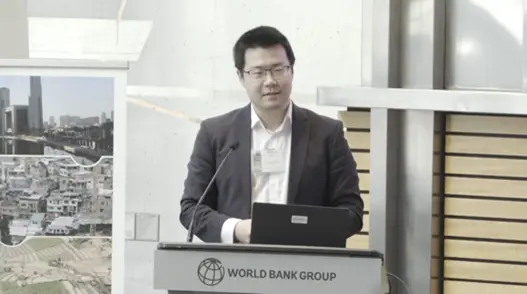
On 1 May, Dr Xiaolun Yu, Lecturer of Real Estate Finance delivered a presentation at the 2026 World Bank Land and Property Research Conference, a global premier venue to discuss research and innovations to land governance, featuring a keynote by Prof. Daron Acemoglu (MIT), 2024 Nobel Laureate in Economics.
Xiaolun presented his research on regulatory tax, land, and housing markets in China and received positive feedback. He engaged in discussions with leading scholars and policymakers at the conference. You can watch Xiaolun’s presentation via https://youtu.be/2D_wZmmev6s?t=3530
Ren Ren awarded the University ECR Output Prize for the Prosperity & Resilience theme
 Ren Ren, Lecturer in Real Estate at the Department of Real Estate and Planning (REP), has won the University ECR output Prize for the Prosperity and Resilience theme. This is the second time in a row that REP has won this prize! The paper is titled “Housing supply elasticity and government-owned land: evidence from Hong Kong” and is co-authored with Siu Kei Wong and Kwong Wing Chau, both from the University of HongKong. It was published in the Journal of Economic Geography.
The paper examines why housing supply responds weakly to rising demand in many cities, focusing on the role of land ownership. It finds that public land can reduce development barriers and costs, making housing supply more responsive in Hong Kong. The findings highlight how institutional arrangements around land ownership matter for housing affordability and suggest that better use of public land could help governments address housing shortages in highly constrained urban areas

- Funder: Economic and Social Research Council
- Title: Funding the Future: How Public RDI Shapes Knowledge Diffusion, Breakthrough Innovation, and Technological Transformation
- Total bid: £232,232

Publications
Kladakis, G. and Skouralis, A. (2026) Election cycles and systemic risk. Journal of Banking & Finance, 187 (In press).
Abstract - We examine whether election periods are associated with systemic risk. Our sample comprises banks from 22 OECD economies over the period 2000 to 2023, and covers 147 national elections. The findings indicate that systemic risk increases during election and post-election periods, while it is reduced in the pre-election period in the case of end-of-term elections. More specifically, the year in which elections occur is associated with a 3.57% higher systemic risk relative to the overall average. The results can be attributed to the suppression of negative information and expansionary fiscal policies in the period before elections. Notably, the impact is more pronounced for snap elections and when the incumbent government is not re-elected. The effect is also stronger in common-law countries, where more market-based financial systems transmit political shocks more rapidly than in civil-law jurisdictions. In addition, we find that macroprudential policies, strong economic growth, trust in the current government and banks’ financial health can partially mitigate the impact of elections on systemic risk. Finally, to alleviate endogeneity concerns, we employ two instrumental variables, namely, term limits and an election uncertainty index based on Google Trends and the results hold and confirm our previous findings, further validating the robustness of our analysis.
