

REP Research Roundup - March 2026
R-LAC 5th Anniversary Symposium and Public Lecture
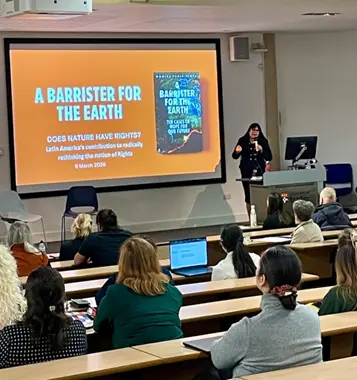 The University of Reading’s Reading Latin America and the Caribbean (R-LAC) Research Network celebrated its 5th anniversary on Monday 9 March with a vibrant afternoon symposium showcasing the breadth and depth of Latin America-focused research across the University, followed by a keynote public lecture from preeminent international barrister Mónica Feria Tinta.
Dr Claudia Murray (Real Estate & Planning) presented a critical reflection on how neoliberal housing regimes have shaped access, land, and rights across Latin America for decades. Drawing on comparative research from Argentina, Chile and Colombia, she showed that ownership oriented policies, promoted across governments of different political leanings, have created a persistent path dependency that limits experimentation with more inclusive models. She highlighted how market logics increasingly permeate not only formal housing but also informal settlements and Indigenous or communal land systems, narrowing the range of viable alternatives. Murray called for a pluriversal housing agenda that recentres community-led and Indigenous land practices and opens space for more diverse, context-responsive housing futures.
MSc Real Estate and MSc Real Estate and Finance students on Athens fieldtrip
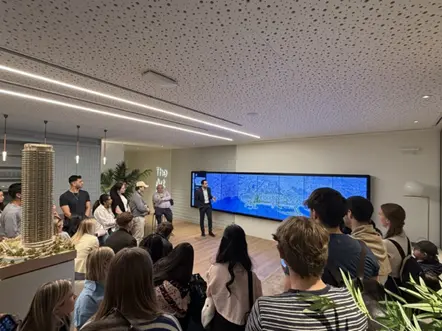 A total of 158 postgraduate students from the MSc Real Estate and MSc Real Estate Finance programmes in the Department of Real Estate & Planning took part in a six‑day real estate field trip to Athens, Greece, held from 1–6 March.
The trip, together with its associated project work, forms part of a capstone module designed to integrate and apply students’ core real estate skills while deepening their understanding of real‑world market issues through a comprehensive case study of the Athens property market.
The Department extends its sincere thanks to the following industry partners, who generously hosted project visits and delivered presentations during the trip: Avison Young, CBRE, Colliers, DCarbon, Dimand Real Estate Development, GEOAXIS Property & Valuation Services, Hyatt Hotels, Lamda Development, OTE Estate, PRODEA Investments, and the Stavros Niarchos Foundation Cultural Center (SNFCC).
We are also grateful to academic colleagues from the Athens University of Economics and Business (AUEB), the Foundation for Economic and Industrial Research (IOEB), and theNational Technical University of Athens (NTUA) for providing insightful presentations that enriched the students’ learning experience.
MSc Spatial Planning and Development fieldtrip to Berlin.
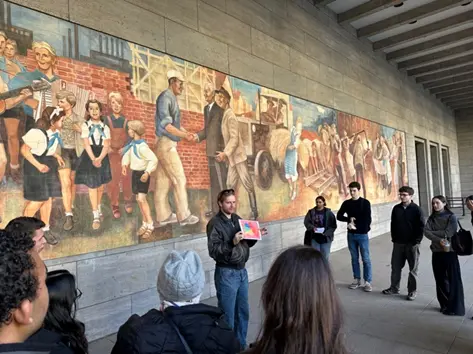
26 postgraduate students from the MSc Spatial Planning & Development and MSc Urban Planning & Development in the Department of Real Estate & Planning took part in a week-long international field trip, starting with a day and a half in Amsterdam, followed by four days in Berlin, exploring the context for planning and development in each city.
The students were encouraged to bring the perspective of a researcher, to develop their understanding of each place through listening, observing and experiencing them, as well looking at supporting data, readings and policy documents. Using a combination of these, the students are now developing case studies of the differences between planning and development in the two cities and the UK, in order to identify what we can learn through these comparisons.
We would like to thank Berlin Municipality, Metrex and CityLab for hosting our students and helping them to understand planning, housing and digital experimentation in Berlin. We would also like to thank our excellent tour guides; Eva and Huibert (Amsterdam Odyssey) in Amsterdam, and Theo (Discover Berlin) in Berlin - they gave the students an invaluable introduction to the overlapping themes of history, sustainability and development in each city. We were also fortunate to be able to visit some landmark places, from the historic beauty of Potsdam, to the iconic Reichstag and TV Tower and the community-led repurposing of the former Tempelhof Airport.

Research Bids
Lukas Makovsky – ESPON
- Title: An ESPON barometer on European local housing markets (WEBHOUSE)
- Total bid: £66,797
Xiaolun Yu – Leverhulme Trust
- Title: Uncontrolled Urban Sprawl, Internal Migration, and Land Use Planning
- Total bid: £235,891
Ziyou Wang – Regional Studies Association
- Title: When Green Meets Growth: Environmental Governance and the Political Economy of Land Use in China
- Total bid: £5,442

Publications
Chioveanu, I., Gu, Y. and Wenzel, T. (2026) Firm prominence and price framing. Journal of Economic Behavior & Organization, 243.
Abstract
This paper explores the strategic use of price framing in a duopoly where firms differ in their prominence and where both frame differentiation and frame complexity are sources of consumer confusion. It analyzes the interaction between the relative effectiveness of the two sources of consumer confusion and firms' prominence levels, and its impact on equilibrium outcomes. A parametric condition on firms' prominence delineates different equilibrium outcomes and synthesizes the interaction between firm prominence and consumer confusion. In equilibrium, firms do not always coordinate on the most effective source of confusion. The impact of consumer protection policy on market outcomes, especially consumer surplus, depends crucially on underlying market conditions, and can be ineffective or even detrimental to consumers.
Daniel, I. D. Fateye, T. B., Daniel, E. I. and Ehwi, R. (2026) Do REITs hedge inflation? Evidence from mature and emerging markets: a comparative analysis of the United States, United Kingdom, South Africa, and Nigeria. Journal of Property Research. (In Press)
Abstract
This paper conducts a comparative assessment of Real Estate Investment Trusts (REITs) inflation-hedging effectiveness across both mature (United States and United Kingdom) and emerging African (South Africa and Nigeria) markets, thereby situating African REIT performance within a broader global context. The investigation across these four markets was conducted over the period 2013 to 2024. Grounded in the Fisher hypothesis and its Fama-Schwert extension, the study decomposes inflation into actual, expected, and unexpected components, and analyses their relationships with REIT capital returns. Using indexed monthly data and a suite of econometric models including ARDL for the main analysis, and FMOLS, DOLS, and CCR for robustness checks, we find mixed and often adverse inflation responsiveness across the sample. Notably, REITs in Nigeria exhibit strong hedging against unexpected inflation despite institutional fragility, while South African REITs demonstrate weak or negative inflation responsiveness. Conversely, REITs in the US and UK offer partial or limited protection, particularly in short-run scenarios. Our findings challenge the notion that REITs offer uniform inflation hedging across global markets and highlight the importance of institutional structure, inflation volatility, and asset composition. The study underscores the need for investors and policymakers to contextualise REIT performance within both macroeconomic environments and market-specific frameworks.
Maidment, C. and Chettiparamb, A. (2026) Civic societies and the planning process Part B: understanding the drivers behind how civic societies engage in planning. Report. University of Reading, Reading. pp38.
Abstract
This report draws on data collected through a survey questionnaire sent to all Civic Voice member societies with the aim of better understanding the contemporary role that civic societies play in the English planning system. It is a follow up to Part A, which was published in February 2022 (see Maidment & Chettiparamb, 2022).
The Part B report highlights that it is not necessarily the case that civic societies engaging in planning have a strong relationship with their LPA. If anything, there is some evidence that stronger relationships occur when planning is part of a wider portfolio of themes and activities that civic societies engage with. Similarly, there are multiple factors influencing the breadth and depth of societies’ engagement with planning. Spending a lot of time in the planning system or engaging with a lot of individual applications is not necessarily a strong predictor of depth of engagement with the community, This would signal that civic societies with a stronger relationship with communities and have a broader place-based knowledge are better placed to leverage this and use it to form stronger relationships with the LPA. Indeed, if there is one overall message, it is about the need for civic societies to find a balance of activities that strengthen their community/place quality facing activities, rather than engaging in planning at the expense of all else. While planning can be helpful to civic societies looking to engage with their communities, it is other issues that appear key to deepening this engagement. To strengthen this community/place quality interface, civic societies will need to strategically think about evolving themselves to broaden their reach in terms of themes that are relevant across communities.

PhD News
PhD Vivas
Adele Wylie
Title: “Foodwork on the margins: care, solidarity and mutualism in Manchester and Stockholm in times of crisis”
Supervisors: Mike Goodman (Geography) and Richard Nunes (Real Estate and Planning).
